Why Sports Matter in the Education System of Tomorrow
30 October 2026
Ask most people what school is for and you will hear a familiar list: reading, writing, mathematics, science, maybe history. Sports tend to arrive late in that conversation, if they arrive at all. They are treated as a break from the "real" work, a reward for good behavior, or a convenient way to keep energetic children occupied. That framing is not just outdated. It is a strategic mistake, and it is one that the education system of tomorrow cannot afford to keep making.
The case I want to make here is not that sports build character in some vague, inspirational-poster sense. It is that sports are one of the most efficient environments we have for teaching the exact capabilities that a fast-changing, uncertain future demands: self-regulation, collaboration under pressure, resilience after visible failure, and the ability to keep functioning when the plan falls apart. These are hard to teach from a textbook. They are almost impossible to avoid learning on a court, a track, or a field.
This article is for the people who actually make decisions about time, money, and curriculum: school leaders, teachers, parents, coaches, and policymakers. I will explain why sports deserve a central rather than peripheral place in future education, where the arguments for them are strong and where they are oversold, and how to build a sports program that earns its place rather than merely occupying it.

The Core Argument: Sports Teach What Classrooms Struggle To
Let me start with the underlying mechanism, because most conversations about sports in education skip it.A classroom, by design, isolates cognitive skill. You sit still, you suppress your body, you work alone, and you are measured on a single dimension. That is a useful environment for some kinds of learning. It is a poor environment for others. The skills that determine adult success are rarely purely cognitive. They are behavioral and social: managing frustration, reading a room, adjusting when a teammate is having a bad day, committing to a boring process for months before seeing results.
Sports create what researchers would call "authentic pressure." The outcome is real. The clock is running. Your teammates are watching. You cannot quietly disengage the way you can drift off during a lecture. That pressure is the teaching tool. A student who misses a free throw with the game on the line and then has to keep playing has just practiced emotional recovery in a way no worksheet can replicate.
This is why sports work: they make consequences immediate, social, and survivable. The stakes feel high but the actual cost is low, which is the ideal condition for learning. A child can fail publicly in a safe setting, process it, and try again next week.
Why the "Physical Health" Argument Is Necessary But Not Sufficient
The standard justification for school sports is physical fitness, and it is true that regular activity supports health, concentration, and mood. But if fitness were the only goal, a mandatory PE class would do the job. The deeper value is in the structured, competitive, team-based formats where the social and psychological lessons live. Schools that treat sports purely as a fitness obligation tend to get fitness-only results, and often not even that, because students disengage from anything that feels like a chore.The real leverage is in the overlap: physical effort plus shared goals plus visible stakes. That combination is rare in a school day, and it is exactly what sports provide.
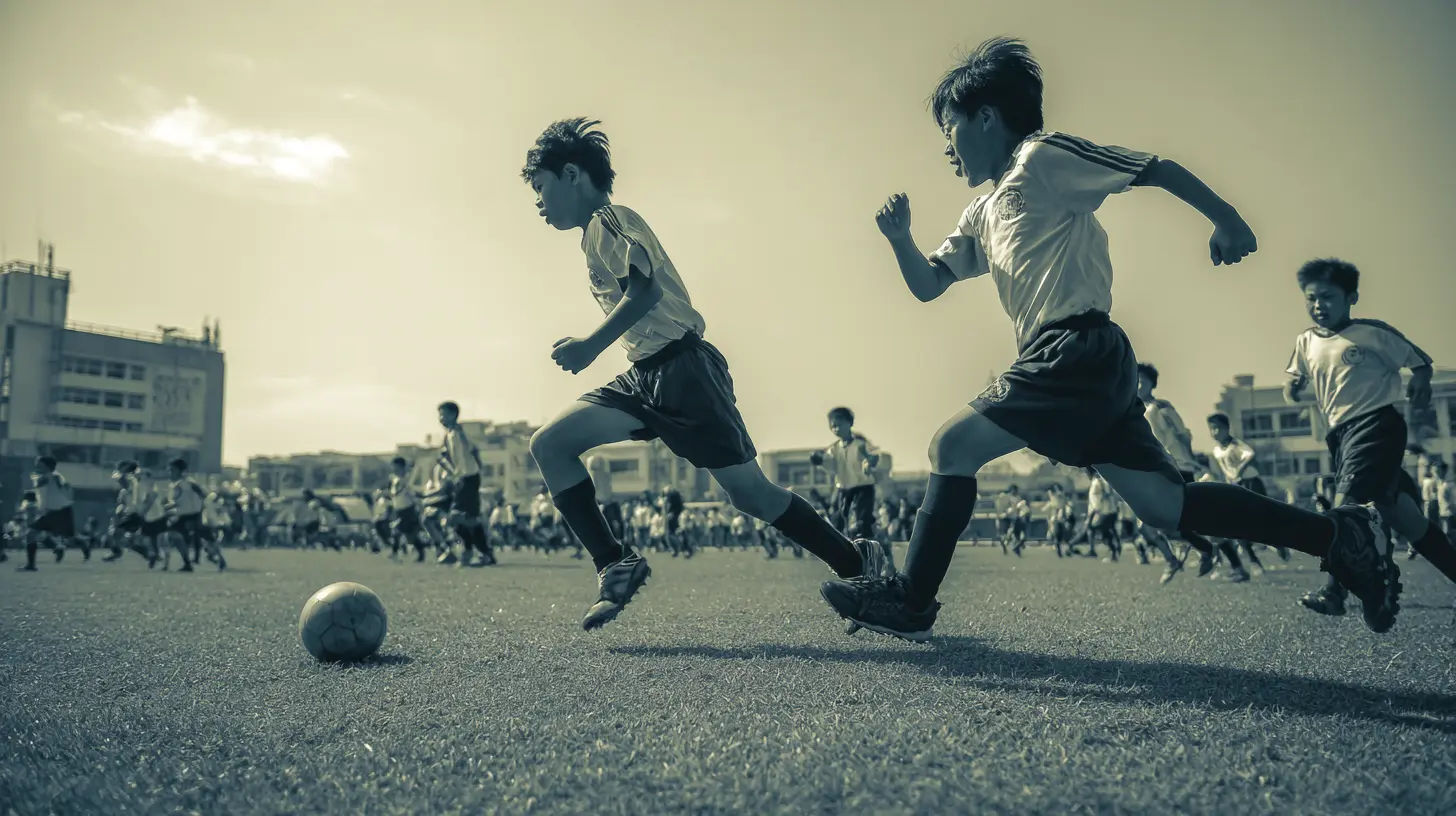
What Sports Actually Build, and How
It helps to be specific rather than sentimental. Here is what sports reliably develop, and the mechanism behind each.Self-Regulation Under Stress
Sport forces you to manage your body and emotions in real time. A gymnast preparing for a routine, a point guard running an offense, a distance runner pacing the final lap: all are practicing the deliberate control of attention and arousal. This is the same skill a student needs before an exam or a presentation. The transfer is not automatic, but the underlying capacity, the ability to calm yourself and focus when it matters, is genuinely trained.Collaboration With Unequal Roles
Team sports teach something that group projects usually fail to: that collaboration often means subordinating your preferences to a shared outcome. The star player has to pass. The bench player has to stay ready. The defender does unglamorous work that makes someone else's highlight possible. This is a more honest model of adult teamwork than the typical classroom group assignment, where one student often does the work and everyone gets the grade.Resilience Through Visible Failure
In most academic settings, failure is private and permanent, recorded in a gradebook. In sport, failure is public and temporary. You miss the shot, you run the next play. That rhythm, repeated over a season, builds a healthier relationship with setbacks than most students ever develop from tests.Discipline as a Byproduct, Not a Lecture
Coaches do not usually give lectures on discipline. They create routines: show up on time, warm up properly, execute the drill. Students internalize the value of those routines because they experience the consequence of skipping them. That is a far more durable lesson than being told discipline matters.
The Future-of-Work Case for Sports
Look at what employers and educators increasingly say they need from graduates: adaptability, communication, the ability to work with people unlike themselves, comfort with ambiguity, and the capacity to learn from feedback. These are not new demands, but they are becoming more central as routine cognitive work gets automated.Sports are an unusually good training ground for exactly these traits. A player has to read an unfolding situation, communicate quickly, adjust to an opponent's strategy, and accept coaching feedback in front of peers. That is a compressed version of professional life.
Consider a concrete comparison. A student who spends those hours in an additional test-prep course may gain a marginal score increase. A student who spends them on a team may gain something harder to quantify but more durable: the experience of being depended on by others and of depending on them. Schools that only optimize for the measurable will keep underinvesting in the things that matter most, because the most valuable outcomes are often the least easy to score.

Where the Case for Sports Gets Oversold
I would be doing you a disservice if I only argued one side. The claim that "sports build character" is true in the aggregate and false in specific cases. It depends entirely on how the program is run.The Character Myth
Sports do not automatically produce good people. A poorly run program can teach arrogance, exclusion, and the idea that winning excuses behavior. If a coach tolerates disrespect toward opponents, benches the less talented without explanation, or models rage at officials, students learn those lessons just as efficiently as the positive ones. The environment is the curriculum. A toxic team culture is a toxic curriculum.The Opportunity-Cost Problem
Every hour on the field is an hour not spent elsewhere. For some students, especially those struggling academically, a heavy sports commitment can crowd out the support they need. The honest position is that sports are highly valuable for most students and need to be balanced against individual circumstances, not treated as universally beneficial regardless of dose.The Equity Trap
School sports can widen inequality if access depends on family money, transportation, or early specialization. A program that only serves the already-athletic, already-resourced students is not an educational program. It is a selection mechanism dressed up as one. The education system of tomorrow has to design for broad participation, not just elite performance.Common Mistakes Schools Make With Sports
These patterns show up again and again, and each one undermines the very benefits that justify sports in the first place.Treating Sports as an Add-On
When sports are scheduled around the academic day rather than integrated into it, they get cut first when budgets tighten. The fix is structural: give physical and social-emotional learning a real place in the timetable and the budget, not a conditional one.Overemphasizing Elite Teams
A school that pours resources into a handful of competitive teams while offering little for the majority is running a spectator program, not an educational one. The students who most need the developmental benefits are often the ones least served by elite-only models.Ignoring the Coach as Educator
Coaches are teachers, and they should be hired, trained, and evaluated as such. A volunteer with deep sport knowledge but no understanding of adolescent development can do real harm. Investing in coaching quality is one of the highest-leverage moves a school can make.Early Specialization
Pushing children into a single sport at a young age raises injury risk and burnout, and it narrows the developmental range that multi-sport participation provides. Schools should actively encourage sampling rather than quietly rewarding specialization.Measuring the Wrong Things
If the only metric is wins, the program will optimize for wins. Schools should track participation rates, retention, injury rates, and student-reported experience alongside competitive results.
Designing a Sports Program Fit for Tomorrow
So what does a good program look like? Not a bigger version of the traditional one. A smarter one.Prioritize Broad Participation Over Elite Narrowness
Offer a wide range of activities, including non-traditional and individual sports, so that students who do not fit the football or basketball mold still find a home. Intramural and recreational tiers matter as much as varsity. The goal is that every student finds at least one physical activity they will continue after school ends.Integrate Rather Than Isolate
Connect sports to the rest of the curriculum where it is genuine. Health classes can discuss recovery and nutrition. Physics can explain projectile motion using the school's own teams. Leadership programs can train captains in communication and conflict resolution. These links make sports feel like part of the education rather than an escape from it.Train and Support Coaches Properly
Give coaches professional development in pedagogy, safety, and adolescent psychology. Pay them as educators. Create clear expectations around sportsmanship, inclusion, and the treatment of less skilled players. A coach who understands why a drill works can adapt it; one who only knows the drill cannot.Build Safety and Recovery Into the Schedule
Concussion protocols, proper warm-ups, rest days, and off-season periods are not luxuries. They are the conditions that make long-term participation possible. Schools that ignore them trade short-term competitiveness for long-term harm.Make Access Genuinely Equal
Provide equipment, transportation, and fee waivers so that cost is not a barrier. Schedule practices at times that work for students with jobs or family responsibilities. Track participation by demographic group and close gaps deliberately.Measure Experience, Not Just Outcomes
Survey students about whether they feel included, whether they are learning, and whether they want to continue. Retention is a powerful signal. If students quit, find out why.A Balanced View: Sports as One Pillar, Not the Whole Building
It would be easy to swing from undervaluing sports to overvaluing them. The right position is neither. Sports are one of several environments that develop the whole student, alongside academics, arts, and community service. They are not a substitute for strong teaching, and they cannot compensate for a school that neglects its core academic mission.The most useful way to think about it is complementarity. Academics develop analytical depth. Arts develop expression and creativity. Sports develop embodied resilience and social coordination. A student who gets all three leaves school with a more complete toolkit than one who gets any single one in excess. The education system of tomorrow should be designed around that complementarity rather than ranking these pillars against each other.
Practical Advice for Decision-Makers
If you are a school leader, start by auditing your current program honestly. Who participates? Who does not, and why? What do students say about their experience? What does the budget actually prioritize? Those answers will tell you more than any external benchmark.If you are a parent, look past the win-loss record. Ask whether the coach teaches, whether your child feels safe and included, and whether the commitment leaves room for sleep, schoolwork, and other interests. A program that produces burnout is not building character; it is spending it.
If you are a policymaker, resist the temptation to treat sports as a line item to cut first. Fund participation and coaching quality, require safety standards, and measure access. The returns are real but they compound slowly, which is exactly why short-term budgeting keeps missing them.
Conclusion
The education system of tomorrow will be judged by whether it prepares students for a world that rewards adaptability, collaboration, and resilience. Sports, run well, are one of the most effective and most underused tools we have for building those capacities. They are not magic, and they are not automatically good. They are a powerful learning environment that depends entirely on the intent and quality of the adults who run them.The choice is not between academics and sports. It is between a school that treats sports as an afterthought and one that treats them as a designed part of the curriculum. The first wastes a remarkable opportunity. The second gives students something they will carry long after the final whistle.
all images in this post were generated using AI tools
Category:
Sports And SocietyAuthor:

Onyx Frye

